

As the weather warms, here's what to know about Ticks, what you can do to protect yourself
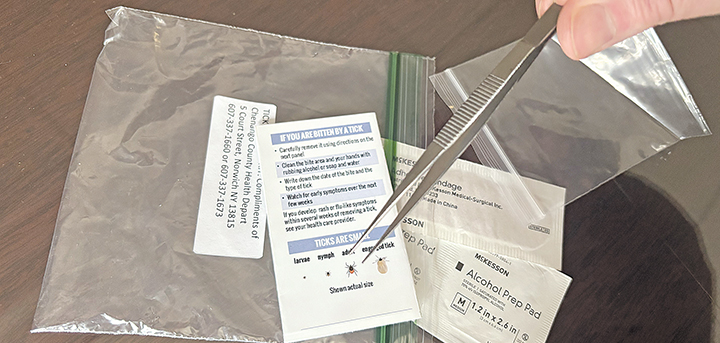
The Chenango County DOH creates a few thousand of these “Tick Kits” each year to provide to residents. They contain instructions on tick removal, metal pointed tweezers, alcohol swabs, a bandage, and a ziplock bag to put the tick into. The kits are available for free on a first come first serve basis. (Photo by Rebecca Laibowitz)
CHENANGO COUNTY - TICKS! Everyone has heard of them. Little bugs that latch on to you and your pets carrying diseases. Ticks start to become active as soon as the weather gets above freezing, but that doesn't mean you need to stop exploring the outdoors.
Here's what you need to know about preventing tick bites, and disease risks according to the Department of Health.
Prepare before you go outside
While you can't 100% stop a tick from attaching to you, you can take multiple steps to prevent bites and spot them before they do. Primarily you should try and “Dress to Repel” as the NYS Department of Health puts it.
This means: wear light-colored clothing so it's easier to spot ticks on your body; wear long-sleeved shirts and long pants to cover your body where they're likely to jump on you; tuck your pants into your socks and your shirt into your pants, this stops the ticks from getting in your clothes and finding crevices to hide; keep long hair tied back; if using a repellent spray make sure to follow the directions and only spray it outdoors, you should also wash off repellent when going back inside.
“Wear light clothes, So you can see them. The nymphs are pretty hard to see, They're very tiny. Tuck your pants into your socks, your shirt into your pants, and that way they have to climb all the way up to get to you, and hopefully you find them like on your face, in your hair, behind your ears. They like any crevices, armpits, groin, behind the knee.They love it. So if you can prevent them from doing any of that. I personally will spray my pants with some kind of deterrent,” said David Gorman, Director of Environmental Health at the Chenango County DOH.
Repellents can be effective to reduce tick bite occurrences but they need to be used correctly to avoid adverse effects, like eye and skin irritation. Repellent products registered by the US Environmental Protection Agency (EPA) have been tested for toxicity and effectiveness, so look for labels with an EPA registration number. You can reduce the need for repellents by dressing with tick bite prevention in mind.
The most common active ingredients in tick repellents are Deet (label may say N,N-diethyl-m-toluamide), Picaridin (label may say KBR 3023), and permethrin which kills ticks on contact and should only be applied to clothing.
When deciding on a repellent, consider what type of pest you are concerned about, what time of day you will be outside, where you will be, and how long you plan to be outdoors. Read your chosen repellent's label carefully to make sure it is effective against ticks, not just mosquitos, and how long it lasts so you know when to reapply. The EPA has an online tool to assist with finding the right skin-safe repellent for your needs, you can find it at www.epa.gov/insect-repellents/find-repellent-right-you
In addition to dressing to repel, and using repellents, the NY Department of Health (DOH) recommends staying on cleared, well-traveled trails, walking in the center of the trails, and avoiding dense woods and bushy areas.
Gorman said, “Ticks typically quest, that's when they've got their arms out and wait to grab onto something, about 18-20 inches off the ground. So they're usually not right on the ground unless they're in some leaf litter, but they're usually hanging out on branches or overhang trails. So if you brush up against them, they grab onto you. So stay in the center of trails if you can.”
It's very important that when you're done being in the outdoors, to conduct a thorough full-body tick check of yourself, your children, and pets. That way it's easier to find and remove a tick on the body especially before it has had time to bite. It's also helpful to bathe or shower once back inside to wash any off of you and more easily find ticks that might be on you.
The Chenango County Department of Health posts signage in areas where the state has found higher concentrations of ticks so people exploring the outdoors can prepare themselves. They are also there for citizens who have questions about prevention and insect ID. If you suspect that a bug you found might be a tick (or even a bedbug) you can bring it to them and they'll let you know what it is.
What to do if you find a tick, and disease risk
If you find a tick latched on to your body stay calm, what matters most is figuring out how long it's been attached.
Generally, people are able to detect and remove a tick before it can transmit pathogens, which depending on tick species and pathogen presence, can take up to 48 hours. Lyme disease is the most prevalent tick-borne disease in New York and the risk of Lyme disease is greatly reduced when the tick is removed within the first 36 hours. If you catch it before that, the chance of getting a tick-borne disease is minimal.
To safely remove a tick NYDOH gives the following instructions:
Use a pair of pointed tweezers to grasp the tick by the head or mouth parts right where they enter the skin. DO NOT grasp the tick by the body.
Pull firmly and steadily outward. DO NOT jerk or twist the tick.
Place the tick in a small container of rubbing alcohol to kill it.
Clean the bite wound with rubbing alcohol or hydrogen peroxide.
Monitor the site of the bite for the next 30 days for the appearance of a rash. If you develop a rash or flu-like symptoms, contact your health care provider immediately.
The Chenango County Department of Health provides free “Tick Kits” consisting of directions on how to remove a tick, pointed metal tweezers, alcohol swabs, a bandage, and a small ziploc bag to put the removed tick into. They give out these kits at their regular Rabies clinics, and provide some to every town in the county to give out to residents who request them. They make between 2000-3000 of these kits each year and they're available on a first come first serve basis.
“What we recommend when somebody calls us and the tick's been on them is we will inform them that they should contact their healthcare provider and let them make the decision as to what happens. And we let them know that if you get the rash, a bullseye rash, that they definitely want to contact their healthcare provider, but not everybody who gets bit by a tick develops that rash. So our other piece of advice is usually if you feel like you have the flu within 30 days of finding that on you, you want to have a conversation with your healthcare provider,” said Gorman.
The NYS DOH conducts regular annual surveillance efforts collecting and testing ticks from locations across NYS to monitor tick-borne pathogens. You can find the latest report here https://www.health.ny.gov/diseases/communicable/lyme/docs/tbd_report_2025.pdf
They also keep track of infection incidences for the common tick borne illnesses anaplasmosis, erlichiosis, babesiosis, and lyme disease, which are reported to the DOH by healthcare providers. In 2025 there were 231 cases of lyme disease, 111 cases of anaplasmosis, 16 cases of babesiosis, and zero cases of ehrlichiosis reported by healthcare providers in Chenango County.
“Out here, every year the state drags different areas around the county, and they collect ticks and they analyze them for what tick-borne viruses they have. And about, usually every year it's between 50 and 52 percent of the ticks collected had Lyme. So basically it's coin toss. If you get bit and it's on you long enough, there's a 50-50 chance you're going to end up with Lyme, or something else, but you can see from the numbers I gave you, everything else is really low,” said Gorman.
It also matters what stage the tick is at in its lifecycle. Ticks hatch from an egg, become larvae, followed by the nymph stage and then become an adult. Adult ticks are more likely to have pathogens than the nymphs and larvae typically don't carry any tick-borne diseases. Adults are typically more active in the fall while nymphs are active in the spring. However there is some crossover as more adult ticks have been found earlier in the year recently.
“They come out as larvae, typically the larvae don't have any diseases, no tick-borne disease. That happens once the nymph feeds. So if they feed on an animal that has it, say a squirrel, and then they live to become an adult, they carry that on with them. And then when they bite the next person and they establish the gut-blood barrier, they transmit it,” explained Gorman.
Keeping grass short helps
If you're worried about ticks on your own property in your lawn, the NYS DOH makes the following recommendations:
Keep lawns mowed and edges trimmed.
Clear brush, leaf litter and tall grass around the house, and at the edges of gardens and stone walls.
Stack woodpiles neatly away from the house and preferably off the ground.
In the fall, clear all leaf and garden litter, where ticks can live in the winter, out of your yard.
Keep the ground under bird feeders clean so as not to attract small animals that can carry ticks into your yard.
Locate children's swing sets and other play equipment in sunny, dry areas of the yard, away from the woods where ticks can be abundant.
Using an approved insecticide once a year, in June, can significantly reduce tick numbers on a residential property.
Keeping your grass cut short does a great job at preventing ticks from being in your lawn according to Gorman who said, “if your grass is cut short and ticks come out there, they're either going to desiccate or they're not going to move out there because of the sun. And if they are getting into your lawn, it's more or less because they're riding on a mouse or a squirrel or some other animal.”
The most common tick species found on humans and capable of transmitting pathogens in New York State, are the black legged tick also known as the deer tick, the American dog tick, and the lone star tick which is rare to find in Chenango County. According to the DOH tick populations have been rising over the last few years and we shouldn't expect it to slow so don't let the fear of a tick bite stop you from enjoying the abundance of nature around us. Keep exploring the outdoors just be sure to take the appropriate steps to minimize your risk of tick-borne disease.
“Protect yourself. Be aware of your environment, if you're in the woods where you're walking, dress appropriately. Check yourself when you're done. It's pretty easy. It's tough if you've got five kids and you have to check on them, especially every day if they're out playing in the yard. I can see where that can become exhausting. But that's the protection we have,” said Gorman.







Comments