

Fire officials invite residents to local Fire Prevention Week events and advise planning ahead for emergencies
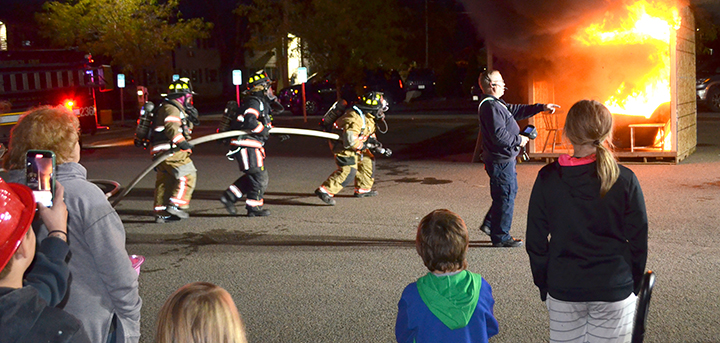
The Norwich Fire Department will host an open house from 5:30 to 8:30 p.m. Wednesday, Oct. 7, at 31 E. Main St. in Norwich as part of Fire Prevention Week. The event gives residents an opportunity to meet firefighters, learn about fire safety and see department equipment. The photo is from a previous year’s event. (Photo by Tyler Murphy)
CHENANGO COUNTY — Fire Prevention Week runs Oct. 4-10, and Chenango County Deputy Fire Coordinator Mike Beckwith is highlighting home-safety basics as residents head into colder months. The national campaign serves as a reminder to check heating devices, test alarms and review family emergency plans before winter arrives.
Several local fire departments are hosting open houses throughout October to give families a chance to meet firefighters, learn about safety practices and explore equipment.
Fire Departments Open House Schedule:
Norwich Fire Department — Wednesday, Oct. 7, 5:30-8:30 p.m.
Sherburne Fire Department — Wednesday, Oct. 7, 6:30-8:30 p.m.
Smithville Fire Department — Friday, Oct. 16, 6-8 p.m.
South Otselic Fire Department — Saturday, Oct. 24
Smyrna Fire Department — Saturday, Oct. 31, 5-8 p.m.
Other departments may also host events. Residents are encouraged to watch for local announcements.
“Fire Safety is a year round event. An estimated 2,600 to 3,000 people die in home fires each year in the United States,” said Chenango County Office of Emergency Services Deputy Fire Coordinator Mike Beckwith. “Please have a working smoke detector and carbon monoxide detector on every level of your home especially outside of your sleeping areas. Have a well maintained heating device and check your chimneys regularly if you use wood for heat,” he added.
Fire Prevention Tips
Fire Prevention Week comes at the perfect time for residents to prepare their homes for winter. As furnaces, wood stoves and space heaters come back into use, Beckwith reminds everyone to inspect devices and make sure all equipment is running safely.
“Any heating devices used in your home should be checked at least by this time of the year to make sure it's in good operating order,” Beckwith said.
This includes checking and cleaning chimneys when needed.
“Chimneys, as well, have them checked, especially if you burn wood,” Beckwith said, “because creosote can build up from improper combustion, and that could spark a chimney fire. Which is one of the causes of house fires,” he added.
Smoke detectors remain one of the most effective ways to protect against home fires. Beckwith reminds everyone to test their smoke detectors at least once a year, with Fire Prevention Week being a good time for an annual inspection. He explained that modern lithium-ion battery-powered smoke detectors typically have a 10-year lifespan but should still be tested. For older models, he recommends testing and changing the battery once a year.
“Test them, make sure they work,” he emphasized.
Beckwith also reminds residents to install and test another crucial piece of safety equipment, carbon monoxide (CO) detectors, noting that CO is a year-round threat.
“That's a deadly gas, that you can't smell or see,” he said.
Improper heating ventilation can cause CO to build up indoors, so it is especially important to ensure these detectors are in working order as heaters come into use.
Have a Plan
Beyond checking detectors and heating equipment, Beckwith said families should take time during Fire Prevention Week to review their home emergency plans. Knowing how to respond when an alarm sounds can make a critical difference.
He emphasized the importance of practicing escape routes and identifying a safe meeting place outside the home. Beckwith noted that while many households say they have a plan, few actually rehearse it. He encourages families to not only practice an emergency exit drill but also identify additional ways to exit in case a fire blocks a route.
“The family should practice an emergency exit drill in the home,” Beckwith said. “So when that detector goes off, whether it's smoke or CO, the family knows how to get out of the house, has an alternate way to get out of the house, and a meeting place.”
Having a meeting place is important so that when the fire department arrives, the family can quickly determine if everybody has made it out and advise responders.
He also encouraged parents and caregivers to involve children in these conversations, especially since many local departments visit schools during Fire Prevention Week.
“Talk to your child about what they practiced, what they saw, what they heard from the fire department, and then doing that in your own home,” Beckwith said.
He explained that reviewing escape routes, checking detectors together and walking through where to meet outside can help reinforce what kids learn at school and make the family's plan more effective.
“Build on that momentum in the home,” he said, “review those things with your child.”
Kitchen and Electrical Safety
Kitchen and electrical fires remain common calls to fire departments. Beckwith emphasized that residents should always begin by calling 911, even if they believe they can extinguish a small fire themselves.
“You want to call the fire department, you want to initiate that call,” he said. “You want to get that series of events started before anything else.”
For grease fires, he recommends keeping a lid nearby to smother flames, never using water and avoiding attempts to carry a burning pan outside, which can spread the fire. Fire extinguishers should be accessible, not buried under clutter, and replaced if they are more than 10 years old or show low pressure.
He added that residents should not cancel the fire department response if a small fire appears to be put out.
“If it's a small fire and your extinguisher puts it out, keep us coming,” he said.
Beckwith cited a case where homeowners thought they had put out a small kitchen fire, but it had actually smoldered in the cupboard and broke out hours later.
Electrical fires can start from overloaded power strips or extension cords placed under rugs or furniture. Space heaters should be plugged directly into an outlet, not into a power strip. If an outlet is smoking or an appliance smells like burning rubber, Beckwith said the safest action is to leave the home and call 911.
Support your local fire departments
Aside from participating in fundraisers and attending department open houses, Beckwith said one of the most meaningful ways residents can support fire prevention efforts is by getting involved with their local departments. Volunteer numbers have declined in recent years, leaving many agencies dependent on neighboring departments for daytime calls.
“The fire departments and emergency squads are really taken for granted,” Beckwith said. “People don't always need to have the fire department come. So when they do, they're expecting a response, but the numbers of volunteers have dropped,” he added.
He noted that volunteers don't always need to be interior firefighters who rush into burning buildings. Departments also need and rely on drivers, exterior firefighters and support personnel who can assist during emergencies.
“If you have time and can volunteer, that's a great way to support your department,” Beckwith said. “I urge people anytime, not just during fire prevention week, contact your local fire department. If you have a couple hours a week that you could donate and do some training and give them that person that maybe could drive the apparatus during the day, that's going to help so much,” he added.
“If we all can help a little bit, it's going to make it better for all of us and our community in the long run,” Beckwith said.
Fire Prevention Week provides an ideal time for residents to refresh their safety habits as they prepare for colder months ahead. From checking detectors and heating devices to practicing escape plans, small steps taken now can make a major difference in an emergency. Consider visiting your local fire department's open house to ask questions about fire prevention and safety and learn how to get involved.







Comments