

St. Bartholomew's 73rd Spaghetti Supper to highlight 100 years of its building’s history
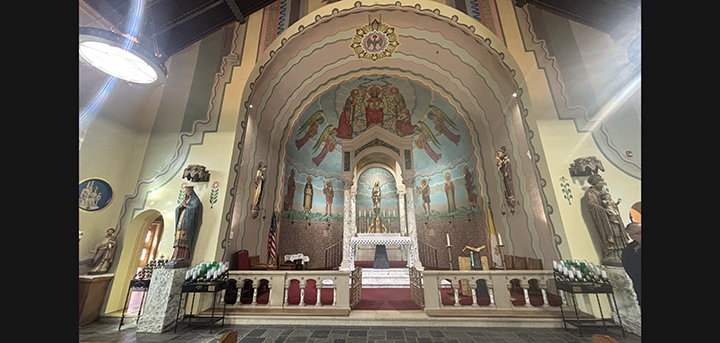
The altar at St. Bartholomew’s is made from imported Botticino, and Breccia marble. The statues of the Blessed Virgin Mary and St. Joseph are also imported from Italy. (Photo by Rebecca Laibowitz)
NORWICH – On Saturday, October 24, St. Bartholomew's Church will host its 73rd annual Spaghetti Supper and also mark the 100th anniversary of the church building on East Main Street. Mass will be led at 4 p.m. by Bishop Douglas J. Lucia. The dinner will be held from 5 to 7 p.m. at the parish center.
This long-running community tradition has become known for its homemade meatballs and sauce. Expecting a large turnout, church trustee and supper organizer Anthony Testani said they have prepared over 1100 meatballs and have 100 pounds of spaghetti ready to serve hungry guests.
To accompany the meal this year, parish historian Anna McLaughlin has organized a special historical exhibit highlighting the craftsmanship and immigrant story behind the church's construction that began 100 years ago. Before the current building was erected, parishioners worshiped in a small mission church on Birdsall and Clinton Streets. A house that once stood on the present church site was moved next door in 1926.
The cornerstone of the current church was laid in October 1926, a handful of years after the parish was formally established with the Diocese of Syracuse. Designed by architect Paul Huber and then built with local bluestone, the building was completed the following year. The cornerstone bears the inscription “A.M.D.G. 1926” which stands for Ad Majorem Dei Gloria, Latin for “To the glory of God.”
“Everything within the building was built with intention,” said McLaughlin.
The architecture and interior of the church is largely influenced by what Testani called a Romanesque style, with imported Italian marble, mosaic work, and statuary. The marble furnishing, statues and Stations of the Cross were crafted by Nardini Art Associates of Boston, while the stained glass windows were created using 15th century glass and made by George W. Sotter of Holicong, PA. They all remain original to the building.
“We often have people come in and visit the church, not necessarily Catholic visitors, just any visitors, and they're always impressed with the artistry of the church. And it does take your breath away when you walk in and you're like, this is beautiful,” McLaughlin said,
“People are surprised by how much art there is in this church,” Testani said echoing her sentiment.
The congregation was founded by mostly Italian immigrants and is still widely known as the Italian church in Norwich. McLaughlin and Testani noted that the Italian founders largely came from the island of Lipari and brought with them a strong devotion to St. Bartholomew who was originally buried there.
“I was always amazed at the hardships that the Italian immigrants had when they first came to America to start new lives. I think it's similar to a lot of other immigration stories. So, you know, their determination and hard work and everything that went involved in sort of building up from that is very amazing,” said McLaughlin. “They were able to start with very little and create one of the more striking pieces of architecture downtown Norwich has,” she added.
While they stopped offering services in Italian decades ago, an Italian influence remains visible in feast-day traditions, the annual spaghetti supper, and the family names that still appear throughout the grounds.
“It’s a continuation of the families that have been here for generations,” Testani said.
St. Bartholomew’s also serves as a steady hub for community outreach in Norwich. The parish center hosts the Norwich Community Kitchen every Tuesday, providing hot meals for 80 to 120 people with help from volunteers across the area. The church is a distribution site for Toys for Tots, Thanksgiving and Christmas baskets, and has long partnered with local organizations for blood drives, voting access, and Chobani’s “Let’s Eat” Week.
“Our strength has always been in our faith formation, in our prayer services and our Masses. But our strength also lies in all of our community outreach programs as well,” McLaughlin said, noting that the parish has always tried to meet whatever needs arise in the greater Norwich community.
Proceeds from this year's supper will support restoration of the church's bluestone sign board, which was crafted to match the building's exterior. The historical exhibit will be displayed in the parish center gymnasium during the event. Portions will later be moving to the church's permanent history room. The room holds a trove of artifacts, and pictures depicting the over 100 years of parishioner activity.
As McLaughlin explained it, “we wanted to celebrate that fact that, after 100 years, it's still standing. All of the generations of parishioners and all of the new parishioners that have followed have kind of done our part to preserve and protect the church building itself so that it still remains architecturally beautiful. And it's still a center of the community.”
The spaghetti supper takes place on Saturday, October 24, from 5 to 7 p.m at a special anniversary price of $12 per person and $10 for children ages 3 to 12, under 3 are free, and takeout is available.

Comments